
Examples#
This chapter showcases the capabilities of PyNetDesign through practical, hands-on scenarios. Whether you are laying out a monitoring network, evaluating its magnitude sensitivity or visualizing the result, these examples give step-by-step guidance. Designed to be both educational and practical, the chapter bridges the gap between the theory of the Methodology chapter and real-world application.
The examples cover ten test monitoring network geometries in a homogeneous velocity model:
Simple station geometry with 3 surface stations in the form of a triangle, from Hallo [2012]
Simple station geometry with 4 surface stations in the form of a triangle with 1 station in the center
Simple DAS geometry with 1 vertical borehole
Combined geometry with 4 surface stations and DAS in a vertical borehole
Geometry with a DAS cable in an inclined borehole
Geometry with a DAS cable in a twice inclined borehole
A 1-km-long DAS cable in a vertical borehole with 1 m channel spacing and constant noise, the homogeneous benchmark of a downhole DAS monitoring study
Geometry with a DAS cable in a deep vertical borehole and noise decreasing with depth
Geometry with a single station above a DAS cable in a deep vertical borehole and noise constant along the borehole
Geometry with a single station above a DAS cable in a deep vertical borehole and noise decreasing with depth
Gallery of examples:
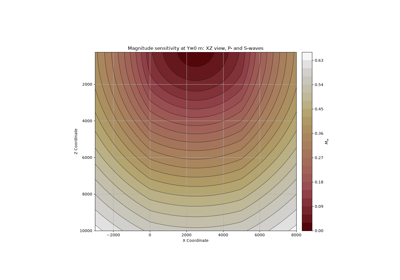
01.1 Magnitude sensitivity for homogeneous model: test case 1
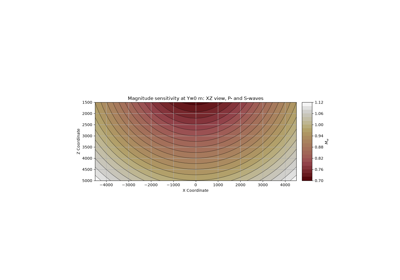
02.1 Magnitude sensitivity for homogeneous model: test case 2
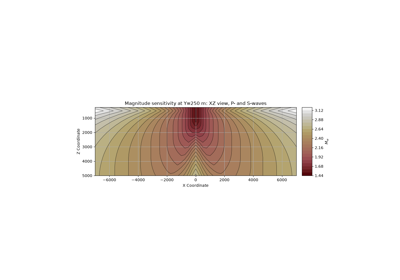
03.1 Magnitude sensitivity for homogeneous model: test case 3
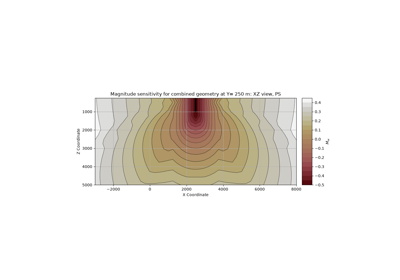
04.1 Magnitude sensitivity for homogeneous model: test case 4
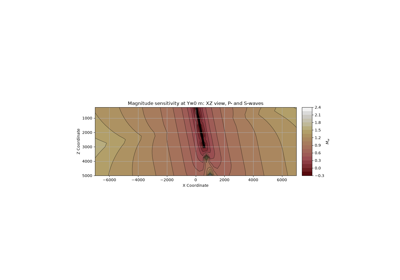
05.1 Magnitude sensitivity for homogeneous model: test case 5
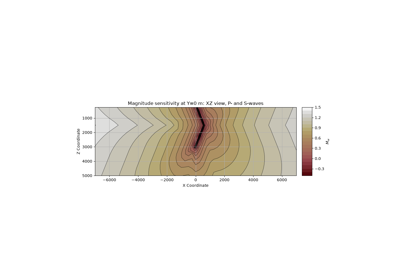
06.1 Magnitude sensitivity for homogeneous model: test case 6
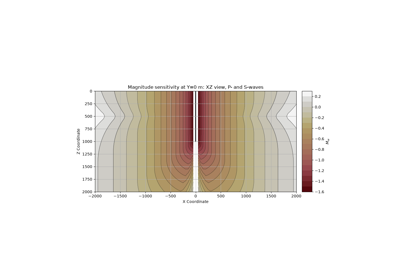
07.1 Magnitude sensitivity for homogeneous model: 1-km DAS array benchmark
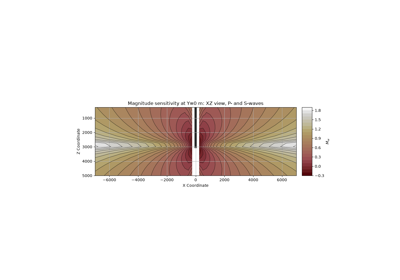
08.1 Magnitude sensitivity for homogeneous model: test case 8
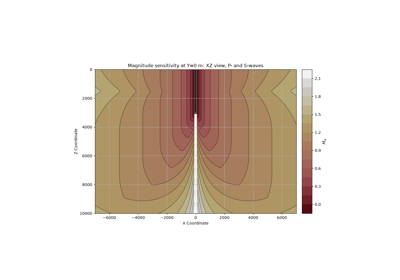
09.1 Magnitude sensitivity for homogeneous model: test case 9
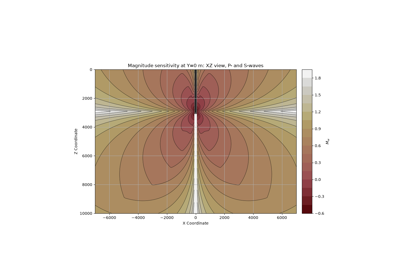
10.1 Magnitude sensitivity for homogeneous model: test case 10